
Anatomy of an AI-Driven Molecular Design Workflow
Published:
Designing a new molecule with AI is rarely a single model call. In practice it is a loop — generate, score, filter, learn — that gradually steers a vast chemical space toward compounds that are potent, selective and actually synthesizable. This post walks through the anatomy of that loop the way we run it in real projects.
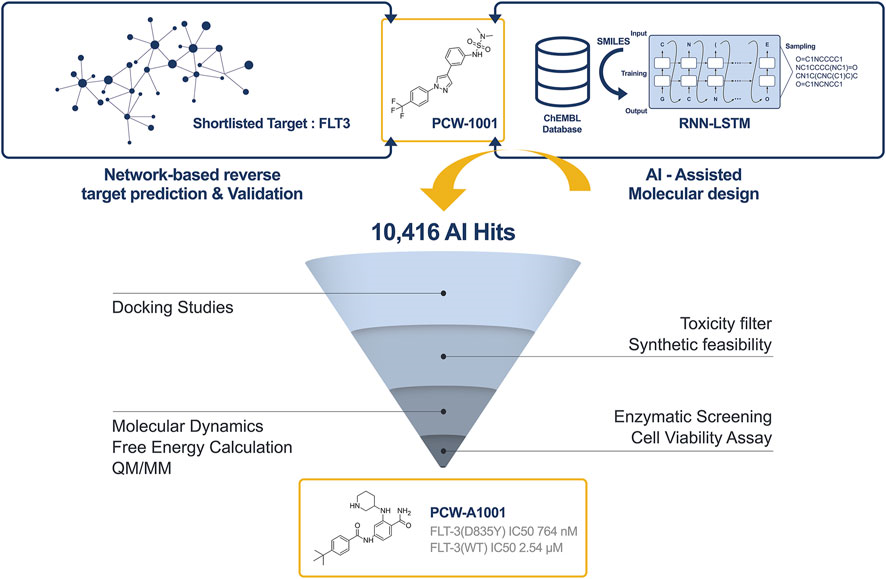
1. Frame the target
Everything starts with the biology. Before a single molecule is generated we pin down:
- the target and, where possible, its structure (a binding site, a mutant of interest such as FLT-3 D835Y);
- known actives and fragments that anchor the chemistry;
- the property profile we want — potency, selectivity, solubility, synthetic accessibility.
This profile becomes the objective the rest of the pipeline optimizes against.
2. Generate
A recurrent neural network with LSTM cells (or, increasingly, a transformer) learns the “grammar” of valid molecules from a SMILES corpus, then samples novel candidates. We rarely design whole molecules from scratch — fragment expansion and scaffold decoration give the model a useful starting point and keep the output grounded in chemistry we trust.
A single 20-epoch run can propose tens of thousands of hits. The interesting work is everything that happens after generation.
3. Filter aggressively
Raw generative output is noisy. We pass it through cascading filters:
- Validity & novelty — parseable SMILES, not already in the training set.
- Drug-likeness & toxicity — structural alerts, ADMET-style red flags.
- Synthetic feasibility — can a chemist actually make it?
Each stage throws away the majority of candidates. That is the point: the cheap filters protect the expensive ones.
4. Score with structure
The survivors go through docking and, for the top tier, free-energy estimates. Ranking by predicted binding plus the property profile from step 1 leaves a short, prioritized list — typically a handful of compounds worth synthesizing.
5. Close the loop
The molecules that get made and tested become new training data. Each cycle sharpens the generator and the scoring models. This is where AI design stops being a one-shot trick and becomes a compounding advantage.
Takeaways
- AI molecular design is a pipeline, not a model — generation is maybe 20% of the work.
- Filters and scoring carry the quality; invest there.
- Keep a human chemist in the loop at every ranking step.
In a previous project this exact loop produced PCW-A1001, a selective FLT-3 (D835Y) inhibitor with an IC50 of 764 nM — a good reminder that a disciplined workflow beats any single clever model.
Leave a Comment